

 English
 Español
Walk into any warehouse, moving facility, or logistics operation and you'll hear "dolly" and "hand truck" used interchangeably — often by people who've been in the industry for years. They're not the same tool. Mistaking one for the other leads to inefficient moves, cargo damage, and unnecessary physical strain on workers.
Content
What Is a Hand Truck?
A hand truck is an L-shaped upright frame with two large rear wheels, a vertical back support, and a small flat ledge at the base called a toe plate. To use it, you slide the toe plate underneath the item on the ground — no lifting required — then tilt the whole frame backward so the load rests against the back support and balances on the two wheels. The operator then wheels it forward.
This design makes hand trucks exceptionally effective for tall, stacked loads: boxes, appliances, filing cabinets, kegs, and similar items that have a natural vertical orientation. The key mechanical advantage is that the load is never fully lifted — it's tilted and rolled, which dramatically reduces the effort needed to move heavy objects over flat surfaces, ramps, and even stairs (with the right model).
Hand trucks typically handle loads between 300 and 600 lbs depending on construction, and their narrow footprint makes them the right tool for corridors, tight doorways, and elevators where a wider platform would be impossible to maneuver.
What Is a Dolly?
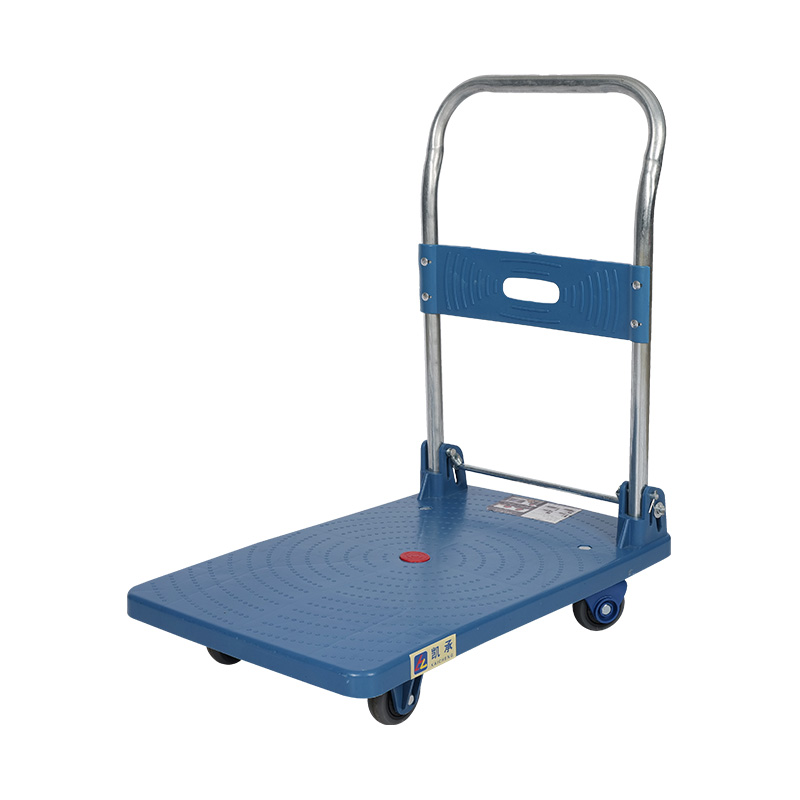
A dolly is a low, flat platform — usually wood or metal — mounted on four swivel casters. It has no handles. To use a dolly, the cargo must be physically lifted or slid onto the platform, after which it can be pushed or pulled freely in any direction across flat floors. The four-wheel design means the dolly stays level at all times, with no tilting required.
This is what makes a dolly better suited to wide, heavy, or irregularly shaped loads that would be unstable on a tilted hand truck: furniture, large appliances, machinery, pallets, or oversized crates. Because the platform stays flat, fragile items are less likely to shift during transit. Cargo can also be strapped directly to a dolly with ratchet straps for added security over longer distances.
Dollies generally carry higher maximum loads than hand trucks — anywhere from 600 lbs for a standard moving dolly up to several thousand pounds for industrial-grade platform dollies. The tradeoff is that they require open floor space to maneuver and can't be used on stairs.
Key Differences at a Glance
| Feature | Hand Truck | Dolly |
|---|---|---|
| Shape | L-shaped upright frame | Flat platform |
| Wheels | 2 large fixed wheels | 4 swivel casters |
| Handles | Yes — built into the frame | No handles |
| Load position | Tilted at an angle during transport | Flat and level at all times |
| Loading method | Slide toe plate under item (no lifting) | Lift or slide item onto platform |
| Typical capacity | 300–600 lbs | 600–2,000+ lbs |
| Best for | Stacked boxes, appliances, tall items | Wide, heavy, or fragile loads |
| Stair use | Yes (stair-climbing models available) | No |
| Tight spaces | Excellent — narrow profile | Limited — wide platform needs clearance |
| Direction of travel | Primarily forward/backward | Omnidirectional |
Design and Structure: Why the Difference Matters
The structural difference between a hand truck and a dolly isn't cosmetic — it determines which physics each tool exploits to make moving easier. A hand truck uses the principle of the lever: the operator tilts the load backward, shifting its center of gravity over the axle, so they're only managing balance rather than supporting the full weight. This works brilliantly for tall, narrow objects but poorly for wide or flat ones that would be unstable when tilted.
A dolly works differently. The four-caster design distributes weight evenly across a stable base, allowing heavy or unwieldy items to be moved horizontally without tipping. There's no mechanical leverage advantage — the operator still needs to lift the cargo onto the platform — but once loaded, even very heavy items glide with minimal push force on smooth floors. This is why dollies are standard equipment in furniture showrooms, warehouses, and stage production, where large items need to move frequently across flat surfaces.
When to Use a Hand Truck
A hand truck is the right choice when the cargo is tall and narrow, when you need to navigate doorways, corridors, or elevators, or when stairs are involved. It's also the better option when you need to move multiple items at once by stacking them vertically — loading boxes onto a hand truck and making a single trip is far more efficient than multiple dolly loads.
Specific scenarios where hand trucks excel: moving stacked boxes during office relocation, transporting appliances between floors, delivering kegs or cylinders, and any situation where floor space is constrained. Convertible hand trucks that switch between two-wheel and four-wheel modes offer additional flexibility when the route changes between narrow hallways and open warehouse floors.
Our one-click folding hand carts are engineered for exactly these conditions — compact when stored, sturdy when deployed, and capable of handling demanding loads across both indoor and outdoor surfaces.
When to Use a Dolly
A dolly is the better choice when the load is wide, flat, or too heavy to tilt safely, when you're moving fragile items that can't be angled, or when omnidirectional movement is necessary. Large furniture pieces, machinery, crated equipment, and palletized goods are all natural fits for a dolly.
In warehouse and logistics operations, dollies frequently work in combination with other equipment: loads are placed onto the dolly using a forklift or pallet jack, then pushed into position by hand. This approach keeps the floor-level movement flexible without requiring the overhead reach of a forklift for every positioning adjustment.
For logistics and warehouse transport, our warehouse logistics trucks and metal fence logistics transport vehicles provide platform-style load support with the structural strength needed for commercial-grade applications. Browse the full metal foldable trolley range to find the right configuration for your operation.
Can One Tool Replace the Other?
In some cases, yes — with compromises. A convertible hand truck with a fold-out platform can approximate a dolly for moderate loads on flat surfaces. But a standard dolly cannot replace a hand truck on stairs or in tight corridors, and a hand truck cannot safely carry wide, flat items that would tip during transport.
Operations that handle diverse cargo types — mixed box sizes, furniture, and machinery — typically keep both on hand. The efficiency gain from using the right tool for each job consistently outweighs the cost of stocking both. For facilities standardizing their material handling equipment, matching the tool to the dominant load type is the faster path to reducing handling time and workplace strain.


