
 English
 Español
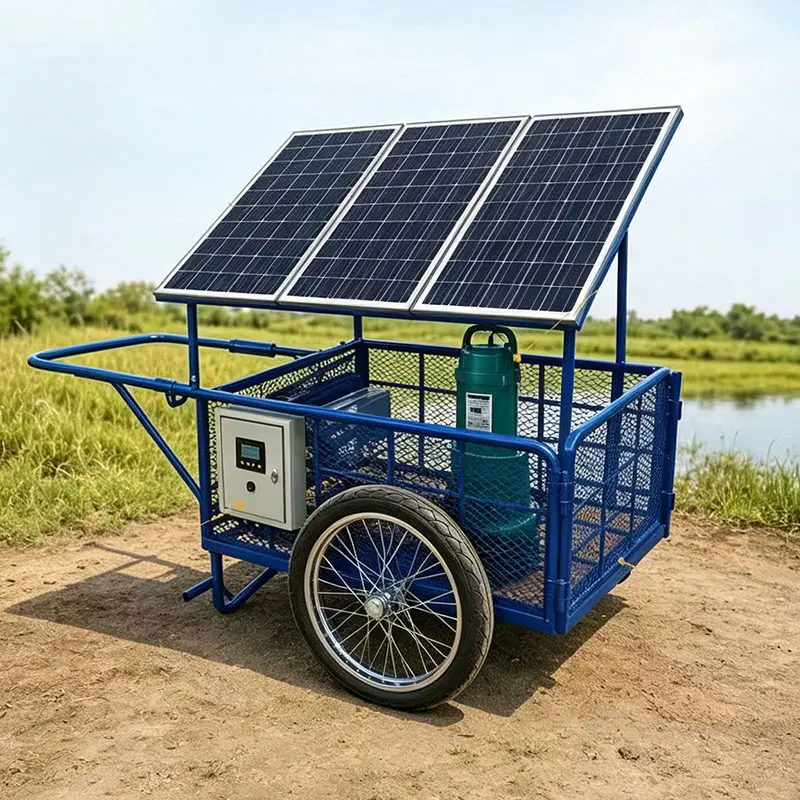
The "Solar-Powered Water Pump Trolley," independently developed by Bintai Machinery of Suqian, Jiangsu, integrates a 1,950-watt photovoltaic array with a 6-inch submersible pump on a single hand-pushed cart. Built around the principle of "solar-generated power, one-person operation, and ready-to-use deployment," it offers a new clean-energy solution for agricultural irrigation in areas beyond the reach of the power grid.
An Overlooked Market Gap: High Power and Mobility Have Long Been Hard to Combine
Over the past decade, photovoltaic (PV) water-lifting equipment has evolved from "demonstration project" to "mature product." According to industry research, the global solar water pump market was valued at approximately USD 4.2 billion in 2025, with a compound annual growth rate exceeding 12%. As the world's largest producer of photovoltaic equipment and a major agricultural nation, China holds a complete industrial chain advantage in solar irrigation, spanning components, controllers, and pumps.
Yet a structural gap has long persisted on the supply side of the market: low-power portable products (200W–600W) offer limited flow and head, meeting only the sprinkler needs of household gardens or small plots. High-power water-lifting equipment (1.5kW and above), while powerful enough, is almost always fixed-installation — requiring leveled ground, poured foundations, and permanently laid-out PV arrays. Upfront investment is high, approval processes are lengthy, and once installed, the equipment cannot be moved; a single unit can serve only one plot of land, limiting asset utilization.
It is precisely this market gap that forms the core logic behind Bintai's product definition.
Product Breakdown: How a 1,950W Solar Array Fits on a Hand Cart
In terms of technical specifications, this system's power configuration is significantly higher than that of common portable solar water pump products on the market.
Photovoltaic Power Unit: The system is equipped with three 650W monocrystalline silicon solar panels, for a total peak power of 1,950W at a system voltage of 48V. The three panels use a folding, collapsible design; once unfolded, they cover a total area of about 6 square meters and feed the pump through an MPPT controller (48V/100A). MPPT (Maximum Power Point Tracking) technology ensures the panels always operate at optimal efficiency under varying light conditions, maintaining relatively high generation efficiency even on cloudy days or during low-light periods at dawn and dusk.
Pump Unit: The system uses a 6-inch submersible pump rated at 1,500W, with a maximum flow rate of 60,000 liters per hour and a maximum head of 15 meters. This flow rate means the system can fill a 60-ton water tank within an hour, or meet the drip-irrigation needs of a single watering cycle for approximately 10–15 mu (about 1.6–2.5 acres) of economic crops such as vegetables, tea, or fruit trees.
Mobile Chassis Unit: The frame is a painted, rust-proofed steel structure measuring 120×80×60 cm, fitted with wear-resistant swivel wheels; the whole unit weighs about 90 kg. Field testing shows a single person can push the cart across field ridges, muddy ground, and gravel roads. The system comes pre-assembled and modular — the pump, piping, controller, and display gauges are all fixed to the frame, so users can complete deployment without any specialized tools.
Control and Protection Unit: Standard features include an MPPT controller, overload protection, undervoltage protection, and short-circuit protection, along with a control panel that displays voltage, current, and power in real time. For users in remote areas, this "visible" operational monitoring effectively reduces the difficulty of troubleshooting and the cost of maintenance.
Economic Analysis: Zero Fuel Cost Drives a Fast Return on Investment
In terms of overall operating cost, this system differs significantly from a conventional diesel-powered water pump. Based on 8 hours of daily operation over a 60-day irrigation season each year: a standard diesel pump consumes about 2–3 liters of fuel per hour; at a current diesel price of roughly RMB 7.5 per liter, that comes to a daily fuel cost of RMB 120–180, or RMB 7,200–10,800 per year. By comparison, the solar-powered system has zero fuel cost on clear days, requiring only minimal operating expense for occasional pump servicing and cleaning of the panel surfaces.