

 English
 Español
A two-wheeled hand truck is usually the first piece of material handling equipment a new warehouse buys, and it is often the most abused. In a packing bay, a retail stockroom, or a residential delivery route, this L-shaped frame with two wheels and two handles converts a heavy box into a balanced rolling load. The key fact to remember is that no single two-wheeler works everywhere. You need to match the truck to the load, the floor conditions, and the person handling it.
Content
What Is a 2 Wheeled Hand Truck?
A 2 wheeled hand truck, also called a hand trolley, two-wheeler, sack barrow, or bag barrow, is a vertical or slightly reclined L-shaped frame with two wheels near the base, a flat toe plate at the bottom, and handles at the top. When you tilt the truck back, the load rests on the toe plate, the frame, and the wheels, so you only balance the load instead of lifting its full weight.
The working principle explains why this design has survived for more than a century: for compact, moderate-weight cargo, one person can move something that would otherwise require two people or a forklift. The L shape gives you leverage. The toes of the frame slide under a box, then a 15-degree tilt moves the center of gravity close to the axle line, making the load feel substantially lighter.
Two-Wheeled vs. Four-Wheeled: Which Should You Pick?
The main trade-off is stability versus maneuverability. A two-wheeled hand truck has a narrow wheelbase and requires the operator to balance the load, but it handles curbs, stairs, and uneven thresholds much better. A four-wheeled platform truck is stable on flat floors but cannot climb stairs and takes up more floor space.
| Criterion | Two-Wheeled Hand Truck | Four-Wheeled Platform Truck |
|---|---|---|
| Maneuverability | Excellent in tight spaces, can pivot on one axle | Good on open floors, wider turning radius |
| Stairs and curbs | Can be tipped and wheeled up or down | Cannot climb steps |
| Load distribution | Load rests on toe plate and frame | Load sits flat on platform, more stable |
| Footprint | Narrow, easy to store | Wider, needs more storage space |
If you mostly move boxes on smooth, level concrete, a four-wheeled folding flatbed trolley may be faster and safer.
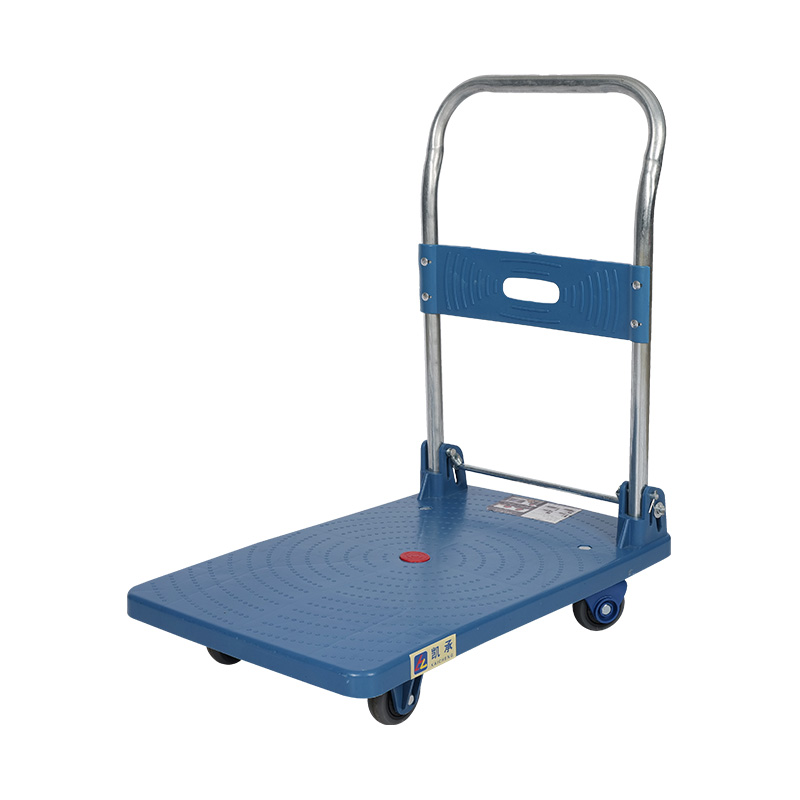 Bintai BT Flatbed Trolley with Four Swivel CastorsA steel flatbed trolley with ergonomic handles and anti-slip surface, ideal for moving boxes on smooth, level concrete in warehouses or factories.View Product →
The Bintai BT Flatbed Trolley folds down to a slim profile when not in use, while its four swivel castors provide stable transport on flat surfaces. But for stairs, ramps, or residential deliveries, a two-wheeler is usually the better fit. For a deeper comparison, see our practical dolly vs. hand truck guide.
Key Specifications to Compare Before You Buy
Five specifications determine whether a hand truck will last through heavy use or fail after a few months. These are load capacity, wheel type and diameter, frame material, handle ergonomics, and folding/safety features.
Load Capacity and Frame Strength
Every two-wheeler carries a rated load plate in kilograms or pounds. Consumer-grade hand trucks often rate between 80 and 120 kg. Professional models start around 200 kg and can exceed 300 kg. The rating depends on the thickness of the steel tube, the quality of the welds at the corners, and the width of the toe plate. A 150 kg capacity is enough for a washing machine, but moving a full commercial keg or a stacked load of lumber requires a 250 kg-rated frame. If you consistently load near the maximum, choose a model with a wider toe plate and reinforced side rails; the extra width also prevents the load from tilting sideways.
Platform Dimensions and Toe Plate Size
The width of the toe plate determines how much of the load is supported. A narrow plate around 20 cm is enough for small parcels; a wide plate of 30 cm or more is required for drums, appliances, and stacked boxes. The length of the frame, from toe to handle, also affects how bulky an item you can tip back. For tall loads like refrigerators, check that the frame has enough vertical reach and a strap system to secure the top.
Wheel Type and Diameter
Wheel size is the most underrated factor. Small wheels, roughly 10 cm in diameter, are fine for polished concrete and are light to lift. Medium wheels of 15 cm handle the thresholds of loading docks and older buildings. For gravel, cracked asphalt, or outdoor yards, choose wheels of 20 cm or larger. Pneumatic tires absorb shocks and roll over bumps, but they need periodic air checks and are vulnerable to punctures. Solid rubber and polyurethane tires are near maintenance-free and resist most warehouse debris. Polyurethane rollers also protect sensitive flooring from black marks, which is important in food or retail spaces.
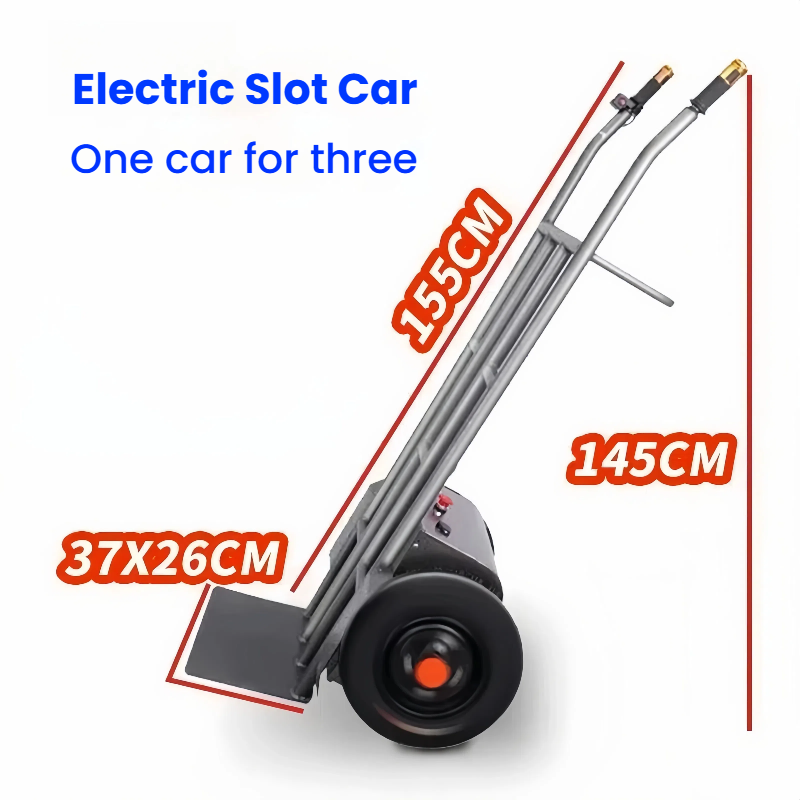 Bintai Electric Two-Wheeled Tiger Bike Load CarrierA compact motorized two-wheeled cart with a 1200 kg capacity and foldable design, suited for heavy loads in narrow aisles and loading ramps.View Product →
When the load is too heavy for a purely manual pull, a motorized two-wheeled model can remove the physical strain. Bintai's Electric Two-Wheeled Tiger Bike adds a drive wheel while keeping the compact two-wheel layout and foldable frame, so it works in narrow aisles and on loading ramps.
Frame Material: Steel or Aluminum
Steel hand trucks are heavier but more durable and cheaper. A typical steel model weighs 8-12 kg; an aluminum model weighs 4-7 kg but costs more and often has a lower maximum load. Aluminum is a better choice if you frequently lift the unfolded truck into a van or work in corrosion-prone environments after marine use. Steel is the right choice for constant industrial loading and for loads above 200 kg. Look for a powder-coated finish on steel frames to protect against rust and scratches.
Handle Length and Ergonomics
The handle should reach your upper thigh when the truck is upright. That height lets you use your leg muscles to start the tilt instead of bending your lower back. A crossbar adds stability for two-hand gripping, while foam or rubber grips reduce hand fatigue. Some models offer height-adjustable handles, which is valuable when several operators share the same truck.
Folding and Storage
Folding hand trucks save the most space in a van or a tool room. A good folding design locks firmly open with a single latch; a weak latch rattles while you move and can collapse if you hit a bump. Measure the folded footprint as well: a unit that folds to less than 20 cm thick slips between shelves or behind doors.
Safety Features
Check for a rubber or foam pad on the toe plate, which stops boxes from sliding forward at the start of the tilt. Angled side edges help when loading drums and round containers. A strap or bungee cord system secures tall loads and prevents them from tipping backward. For stair use, some trucks add a three-wheel stair roller or a central stair crawler; these reduce jolts but add weight and cost.
Using and Maintaining Your Two-Wheeled Hand Truck
Good technique doubles both the life of the truck and the safety of the operator. Always slide the toe plate fully under the load before tilting. Keep heavy items low on the plate, close to the wheels, so the center of gravity stays low. When going up stairs, reverse the truck and pull the handles so the load faces away from you; when going down, pull it behind you and let the wheels take each step. Never jerk the truck sideways on uneven ground, because that bends the frame and stresses the welds.
Monthly maintenance takes about ten minutes:
- Check the axle bolts and wheel nuts for looseness; tighten with a torque wrench if specified.
- Inspect the wheel treads for flat spots, cuts, or embedded debris.
- Wipe the frame with a degreaser, especially after chemical or food spills.
- Lubricate folding joints and wheel bearings with lightweight oil.
- Test the fold latch to confirm it holds firmly under load.
One common mistake is loading the truck too far from the wheels. If the top of the load projects far behind the axle, the truck becomes unstable and may fall over. Keep the center of gravity as close to the wheels as possible, and secure tall items at both the toe and the handle.
Replace a bent frame or broken wheel immediately. A cracked weld can fail without warning and drop the entire load. Keep a spare set of wheels on hand for high-use fleets.
Why the Manufacturer Matters
The frame geometry, weld quality, and finishing of a two-wheeled hand truck separate a tool that lasts ten years from one that fails in two. A manufacturer like Bintai Machinery (Jiangsu) Co., Ltd. brings more than a decade of metal fabrication experience, a 26,000 square meter plant, automated production equipment, and an in-house research lab. That engineering base matters when you are buying a single unit or a container lot for resale.
Bintai's metal trolley range includes folding hand carts, flatbed models, warehouse logistics vehicles, and electric two-wheeled units. Their export record spans European customers who inspect factories before ordering, so the manufacturing tolerances, surface finishing, and packaging are built for international freight and commercial use.


