

 English
 Español
The question comes up constantly in warehouses, moving operations, and logistics facilities: dolly or hand truck? Both move heavy things. Both save your back. But choosing the wrong one for the job means slower work, higher injury risk, and cargo that doesn't arrive in the condition it should. The right answer depends on four variables — and once you understand them, the decision becomes straightforward.
Content
The Four Factors That Drive the Choice
Before reaching for either tool, run through these four questions. The answers will point clearly to one or the other in most situations.
- What shape is the load? Tall and narrow items suit a hand truck. Wide, flat, or bulky items suit a dolly.
- How heavy is it? Hand trucks handle up to roughly 500–600 lbs. Dollies scale much higher — industrial platform dollies routinely carry 1,000 lbs or more.
- What's the route like? Stairs, narrow hallways, and elevators favor a hand truck. Open warehouse floors and loading docks favor a dolly.
- How fragile is the cargo? Items that can't be tilted safely — glass, equipment with internal components, anything top-heavy — belong on a flat dolly platform, not angled on a hand truck.
Most decisions resolve clearly from these four points. The complications arise in the middle cases — loads that are moderately heavy, routes with mixed terrain, or operations handling diverse cargo types daily.
Choose a Hand Truck When the Route Is the Challenge
Hand trucks dominate anywhere the physical environment creates constraints. Their narrow two-wheel profile fits through standard doorways that a loaded dolly cannot. They can navigate 90-degree turns in tight corridors without needing wide turning clearance. And on stairs — which are completely impassable for a standard dolly — stair-climbing hand trucks with auxiliary wheels or a tri-wheel design can move substantial loads floor-to-floor without an elevator.
The mechanical design of a hand truck is particularly efficient for stacked, uniform loads. Moving twenty boxes in a single trip by stacking them on a hand truck is faster than making five separate dolly runs with four boxes each. The hand truck rewards vertical thinking — if you can stack it, you can move it all at once.
Hand trucks are also the standard tool when one operator needs to handle the entire move solo. The upright frame gives the user control through a single handle position, and the two-wheel balance point is intuitive to manage. A loaded dolly without handles requires pushing at the cargo itself, which is awkward for tall loads and doesn't give the operator much directional precision.
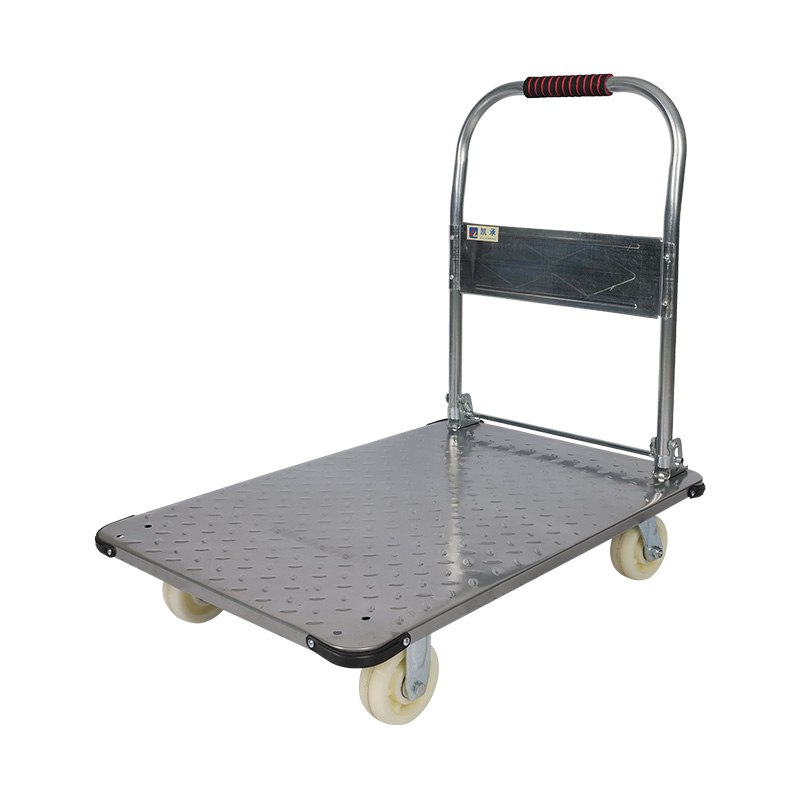
For operations needing a reliable, compact, foldable hand cart that stores efficiently between uses, the one-click folding hand carts collapse flat in seconds and deploy just as fast — practical for facilities where floor space is at a premium.
Choose a Dolly When the Load Is the Challenge
A dolly's flat, level platform is the right answer whenever the cargo itself creates the difficulty — not the route. Wide furniture that would tip on a hand truck, heavy machinery that exceeds hand truck capacity, or fragile items that absolutely cannot be angled are all dolly territory.
The four swivel casters give a dolly something a hand truck can't offer: true omnidirectional movement. Once a heavy item is on a dolly, it can be pushed sideways, rotated in place, or moved diagonally — movements that a two-wheeled hand truck requires repeated repositioning to replicate. In furniture placement, stage setup, or machinery installation where precise final positioning matters, this is a significant time advantage.
Dollies also work better when the load needs to be secured for transport over a longer distance. Ratchet straps can be run across the platform and cargo in any configuration, giving secure attachment without the load-against-backframe arrangement that a hand truck requires. For a warehouse shipping dock where loads travel from storage to truck, a secured dolly load is faster to prepare and more stable in motion.
Our warehouse logistics trucks and metal fence logistics transport vehicles combine platform-style load support with fencing structures that keep cargo contained during transit — eliminating the need for additional strapping on many load types.
When Neither Tool Alone Is Enough
Larger operations often find that the real answer to "dolly or hand truck" is "both, in sequence." A common workflow: use a pallet jack or dolly to move a large item from storage to a staging area, then transfer it to a hand truck for the final stretch through a narrow corridor or up a flight of stairs to the delivery point. Each tool handles the portion of the route it's suited for.
For operations with a high volume of mixed cargo — some tall and stackable, some wide and flat — keeping both tools available and training staff to reach for the right one by default is a straightforward efficiency improvement. The cost difference between the two tools is small; the productivity difference from using the right one is measurable in time-per-delivery and injury rates over a month of operation.
Facilities looking to reduce manual handling entirely for heavier loads can also evaluate powered options. Electric trolleys eliminate the pushing effort on flat surfaces and handle capacities that neither a standard hand truck nor a manual dolly can reach safely. For operations where load weights consistently exceed what manual equipment handles well, that's often the most cost-effective long-term direction.
Explore the complete metal foldable trolley product range — from compact folding hand carts to heavy-duty logistics platforms — to find the configuration that matches your load types and workflow. For powered solutions, the metal electric trolley range covers battery-operated options built for warehouse and industrial environments.
Quick Decision Reference
| Scenario | Better Choice | Reason |
|---|---|---|
| Moving stacked boxes through a narrow hallway | Hand truck | Narrow profile, stacking efficiency |
| Relocating a large sofa across a showroom floor | Dolly | Wide load, flat platform, omnidirectional movement |
| Delivering appliances up a flight of stairs | Hand truck | Stair-capable; dolly cannot handle stairs |
| Moving a 900 lb machine across a warehouse floor | Dolly | Higher load capacity; can be combined with forklift loading |
| Office move: mixed boxes and file cabinets | Hand truck | Handles both load types; elevator and corridor friendly |
| Transporting fragile glass panels | Dolly | Flat platform; no tilting; can be strapped securely |
| Warehouse pick-and-pack with frequent short trips | Hand truck or folding cart | Speed and maneuverability between aisles |
| Furniture showroom repositioning | Dolly | Precise positioning; rotate and slide in any direction |


