

 English
 Español
A 320 kg scissor lift has to come off a box truck at a site with no dock, no forklift, and a driver who wants to leave in ten minutes. Someone unfolds a ramp, hooks it onto the trailer edge, and starts winching. Everything about that operation - how steep the slope is, how heavy the ramp is to lift, whether the side rails hold the wheels - was decided the day the ramp was ordered, usually by whoever quoted the lowest price. That ordering habit is the problem. Three variables settle whether an aluminum equipment ramp survives daily service: the rated capacity at the real load angle, the alloy and wall thickness of the extrusion, and the way the top of the ramp attaches to the trailer. Price is the fourth consideration, not the first.
Content
- 1 What the Capacity Figure on the Label Really Means
- 2 Folding Ramp, Arch Ramp, or Dock Board: Choose by Job, Not by Looks
- 3 Aluminum Versus Steel: Where the Weight Saving Comes From
- 4 Gradient, Push Force, and What One Operator Can Move
- 5 Traction, Curbs, and the Connection at the Top
- 6 Match the Ramp to the Cart It Has to Serve
- 7 Checks Before the Purchase Order Goes Out
- 8 Sourcing Ramps and Rolling Equipment Together
What the Capacity Figure on the Label Really Means
Suppliers quote one capacity number, and that number assumes the load is spread evenly along the deck. Real loads do not behave that way. A 300 kg machine on four small casters puts most of its weight on one rail at mid-span, which is the worst possible position for a beam. A single file of hand carts pushes in the same concentrated way. Two consequences follow.
First, compare the rating against the heaviest single-wheel or single-point load, not the total weight of the machine. Second, check whether the rating applies to a ramp resting fully on the ground or to one cantilevered over the trailer edge; the unsupported span is where deflection and eventual fatigue cracking begin. Reputable manufacturers publish a design safety factor, commonly between 2:1 and 3:1, together with a deflection limit for the loaded deck. If a datasheet offers a single figure and nothing else, treat that figure as marketing rather than engineering.
Folding Ramp, Arch Ramp, or Dock Board: Choose by Job, Not by Looks
The ramp type follows from two measurements: the height the load must climb, and the lowest point on the underside of the machine. A trailer bed at 1.0 m is normal. A loading dock at 1.2 m is normal. The ramp has to span that rise at an angle the equipment can manage, and it has to clear the machine's belly where the ramp meets the deck.
| Ramp type | Typical rated capacity | Usual length | Unit weight | Typical use |
|---|---|---|---|---|
| Single-fold aluminum ramp | 250-450 kg | 1.4-2.2 m | 8-15 kg | Hand carts and light wheeled equipment into vans and pickups |
| Two-fold ramp pair | 400-900 kg | 1.8-2.6 m | 15-28 kg per pair | Ride-on mowers, small loaders, two-wheeled dollies |
| Long arch or multi-fold ramp | 600-1,500 kg | 3.0-4.5 m | 30-60 kg | Low-clearance machines that need a gentle breakover |
| Aluminum dock board | 1,500-4,000 kg | 0.9-1.5 m | 30-70 kg | Bridging the gap between a dock and a trailer, no slope involved |
| Mobile yard ramp | 7,000-10,000 kg | 6-10 m | 900-1,600 kg | Forklifts working from ground level, usually built in steel |
Length and gradient are linked, and the link is unforgiving. A 4:1 ramp for a 1.0 m deck height needs 4 m of deck. A 6:1 ramp needs 6 m. Since most folding ramps stop at 2.5 m, that same 1.0 m trailer bed produces a gradient near 1:2.5, roughly 22 degrees. That is fine behind a winch and hopeless for a person pushing a loaded pallet truck.
Aluminum Versus Steel: Where the Weight Saving Comes From
Aluminum ramps are built almost exclusively from 6061-T6 extrusion, occasionally 6005A-T5. The trade-offs are measurable rather than a matter of preference. Aluminum has a density of about 2.7 g/cm3 against 7.85 g/cm3 for steel, so an extrusion of equal cross-section weighs roughly a third as much. Its modulus of elasticity, however, is about 69 GPa against 210 GPa, which means an aluminum rail deflects close to three times as far under the same load and section.
Deflection, not yield strength, usually governs the design, so aluminum ramps need deeper or thicker sections than a casual comparison suggests. Cost follows the same logic: aluminum extrusion runs two to three times the price per kilogram of mild steel, and that difference is recovered through easier handling, no painting, and no rust maintenance. Two failure modes deserve attention. Welding 6061-T6 degrades the heat-affected zone and can strip roughly 40 percent of the parent metal's strength unless the part is re-aged, so a welded ramp should be qualified by a physical load test rather than an alloy certificate alone. And wherever aluminum touches bare steel in wet or de-iced conditions, galvanic corrosion starts at the contact point, which makes isolation washers and stainless fasteners part of the specification, not an accessory.
Gradient, Push Force, and What One Operator Can Move
Turning a Ratio into a Force
Slopes are written as ratios: 4:1 means one unit of rise for every four of length, about 14 degrees; 8:1 is about 7 degrees; the 12:1 used on accessible building ramps is under 5 degrees. Push force equals the load multiplied by the sine of the ramp angle, plus rolling resistance. At 4:1 the sine is 0.24, so a 400 kg cart demands roughly 97 kg of horizontal push before rolling losses are counted. Ergonomics guidance commonly caps repeated one-person pushing at about 20 kg. That is why a hand truck or a folding flatbed cart needs a ratio closer to 10:1 or 12:1, while a winch, a powered pallet truck, or a motorised tug can work a 4:1 ramp.
Breakover Angle and Kick-Out
The second geometry check covers the angles at the top and bottom of the ramp. A machine with low ground clearance can bridge the gap between ramp and trailer deck and hang up on its own frame, which is exactly why arched, multi-fold ramps exist: the curve spreads the change of direction over a longer distance. At the bottom, a steep ramp tends to slide forward as the load climbs, so a strap or pin tying the ramp to the trailer frame prevents the kick-out that drops a load onto the ground.
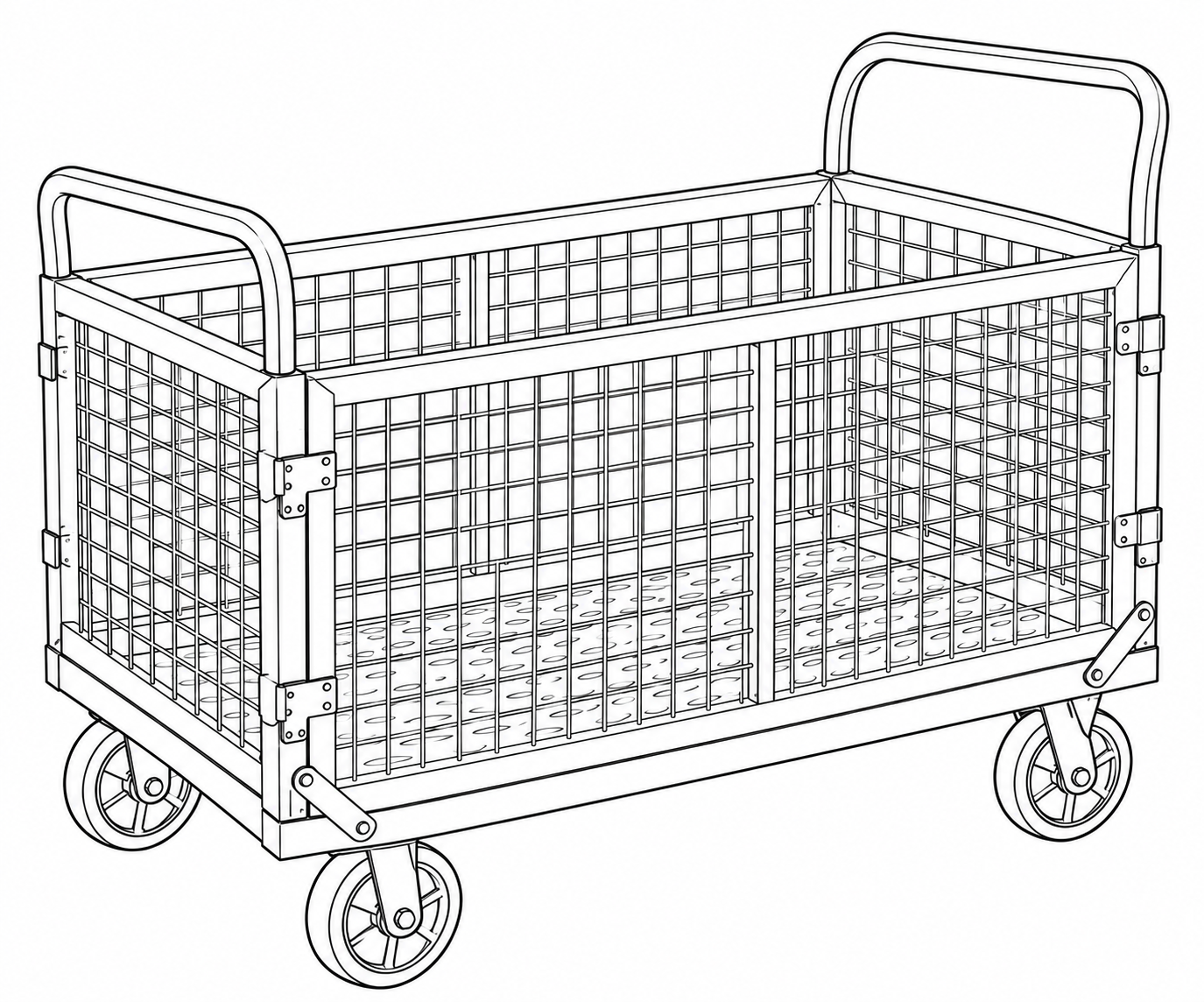
 Bintai Machinery Material Handling and Transport EquipmentBrowse cage trolleys, platform trolleys, side-rail platform trucks, and electric carts; useful when matching material-handling equipment to ramp and trailer loading needs.View Product →
Traction, Curbs, and the Connection at the Top
Three details decide whether a ramp feels safe on a wet morning. The running surface should be extruded with a punched or raised pattern rather than applied as tape, because tape lifts at the edges within a season. Side rails, sometimes called curbs, keep wheels from walking off the deck; 40 mm to 75 mm of curb height suits most casters, while taller curbs obstruct wide machines. The top plate or hook must sit flat on the trailer threshold and never on a tailgate lip or a rubber seal that compresses under load.
A chain, pin, or cam-lock tie to the trailer frame is the only reliable defence against the ramp shifting while a load is halfway up. Where the ramp is used with a hand truck or a folding flatbed cart on small casters, watch how the wheel crosses the joint between ramp and trailer; a sharp step there stops light wheels dead and sends the load sideways.
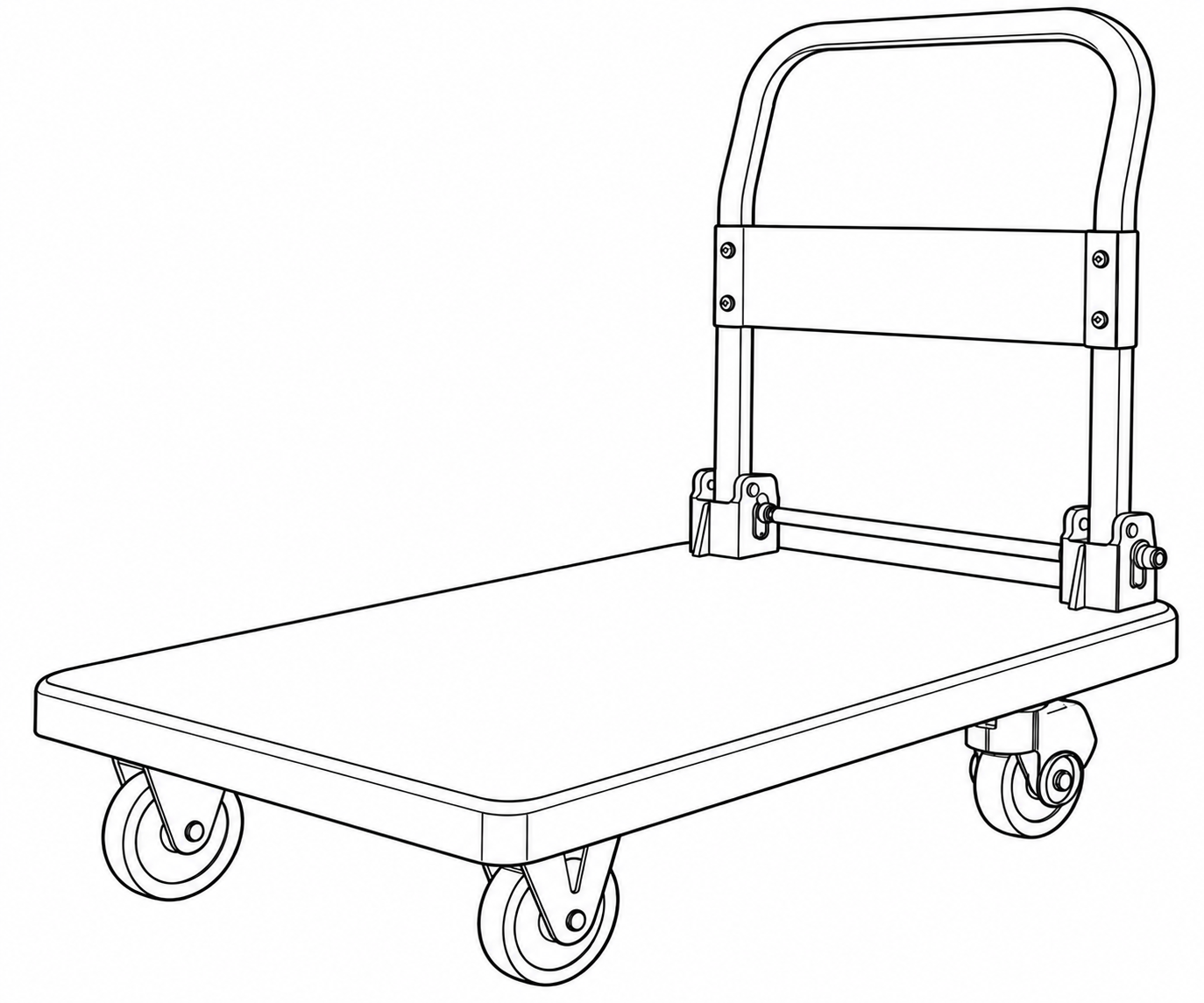
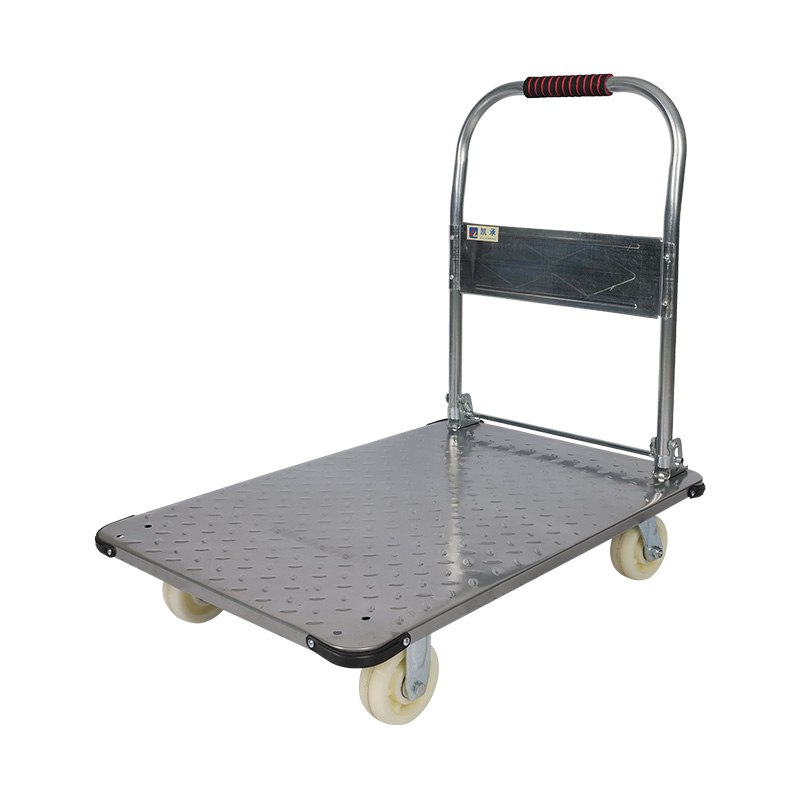 BT-Foldable Silent Flatbed Folding Hand CartFolding flatbed cart with 60 x 90 cm and 47 x 73 cm platform options and 300 kg or 150 kg loads, relevant when matching cart size to ramp use.View Product →
Match the Ramp to the Cart It Has to Serve
Before choosing a ramp, measure the cart. Wheel diameter, wheelbase, load with goods, and the height of the top of the load all matter. A wide-deck folding flatbed cart rolls up a slope more predictably than a narrow two-wheeled hand truck, because the load is shared across four casters and the centre of gravity sits lower. Buyers weighing the dolly versus hand truck decision face the same arithmetic at the other end of the job: the right rolling platform cuts push force as much as the ramp does.
For a typical task - a folding flatbed cart, 150 kg to 300 kg of goods, a 1.0 m trailer bed - a two-piece aluminum ramp of about 3 m, rated for the single-wheel load and fitted with a tie-down chain, handles most days without a winch. Heavier loads or shorter decks push the job toward powered equipment.
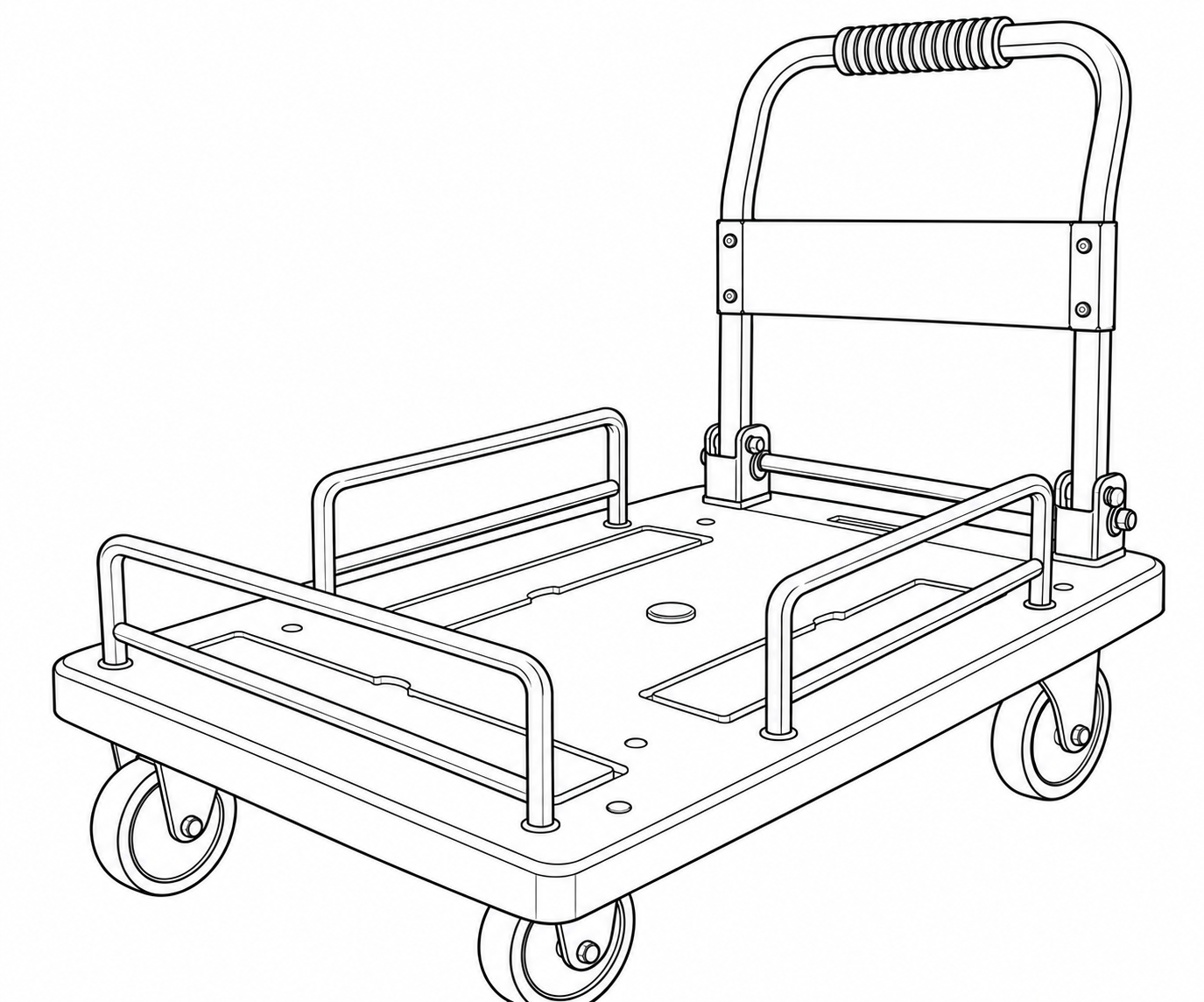
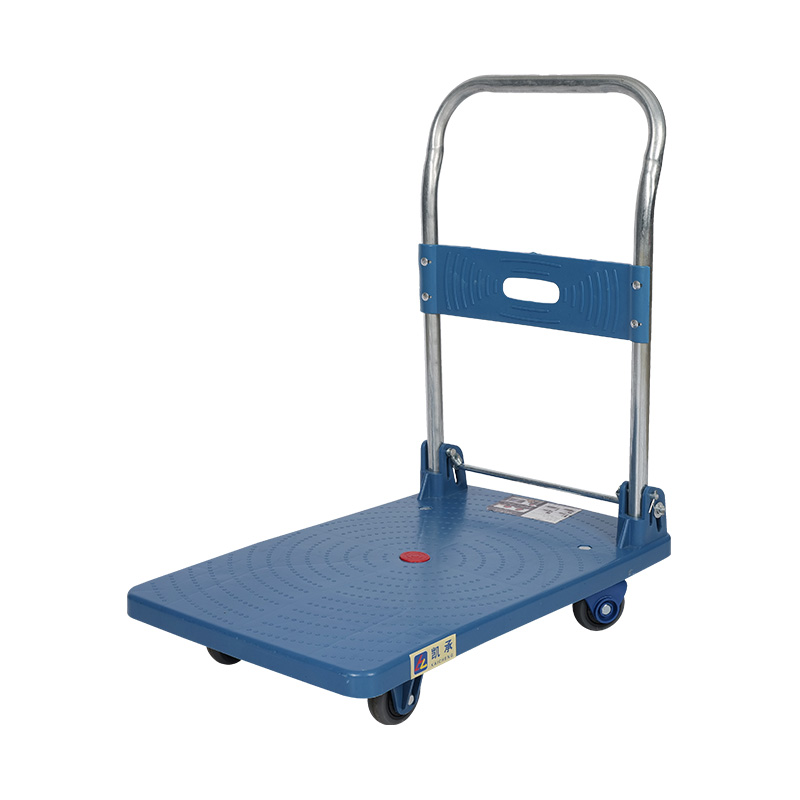 BT-Flatbed Trolley for Warehouse and Industrial Material HandlingHeavy-duty flatbed trolley with steel deck, anti-slip surface, raised edges, and swivel casters, relevant when specifying cart and ramp as one system.View Product →
Checks Before the Purchase Order Goes Out
- Rated capacity for a single wheel load at mid-span, plus the total distributed load.
- Deflection limit and design safety factor stated in writing.
- Ramp weight and folded size measured against the person who lifts it twice a day.
- Top attachment hardware, chain or pin, included and matched to the trailer.
- Traction surface construction and the size of the step at the ramp-to-trailer joint.
- Alloy and temper certificate, plus a load test report when the ramp is welded.
- Spare hinges, pins, and straps, because those parts wear out long before the deck does.
Ordering the ramp and the cart as one system removes the most common mismatch of all, since ramp length and rating can then be specified against a known wheel load and wheelbase rather than a guess.
Sourcing Ramps and Rolling Equipment Together
Metal handling equipment and the ramps that load it usually come from the same purchasing folder, and it pays to keep them there. Bintai Machinery (Jiangsu) Co., Ltd. manufactures folding flatbed trolleys, one-click folding hand carts, warehouse logistics trucks, hydraulic tool carts, industrial isolation fencing, and street furniture at a 56-acre site with 26,000 square meters of workshop space in the Susu Industrial Park, Suqian, Jiangsu. The company runs its own laboratory and automated production lines, supports customization on several product lines, and ships to European markets, with container loading and export packing already part of routine operations.
For a loading programme, that combination matters in three ways: material and test documentation can travel with the goods, the cart that climbs a ramp can be built to known wheel loads and wheelbase dimensions, and factory visits by overseas buyers are an established part of the sales process.
An aluminum equipment ramp is a small line item next to the machine it loads, yet it carries the whole operation. Set the rating against the single-wheel load, keep the gradient inside what a person or a winch can genuinely handle, question the weld behind the alloy claim, and tie the top of the ramp to the trailer every single time. Buyers who specify the ramp and the cart together replace fewer ramps and lose fewer hours.


