

 English
 Español
A route with a 300 lb boxed water heater, six stacked cartons, and a narrow service entrance is where a convertible dolly hand truck proves useful. The operator tilts the load as an upright hand truck, then releases the hinge and lays the frame flat for bulky cases. The conclusion is simple: buy the conversion mechanism and wheel set for the work, not the lowest headline capacity. A 500 lb rating means little if the latch develops play or the casters sink into a gravel apron.
Content
What the Two Positions Really Change
An upright hand truck carries load close to the axle and lets the operator balance it through doorways. A flatbed position spreads the load over a deck, so the frame and casters take more of the weight. The conversion is not cosmetic. It changes the center of gravity, the footprint, and the failure points.
Most convertible models lock in both positions with a pin, spring latch, or cam lever. A good lock engages at two points and leaves no side-to-side rattle when the frame is loaded. A weak lock shows up as a wobble at the hinge, uneven caster contact, or a deck that flexes before the load moves. Buyers should test the conversion under load, not on an empty showroom floor.
| Configuration | Best load shape | Operator effort | Main risk |
|---|---|---|---|
| Upright hand truck | Tall boxes, appliances, stacked cartons | Balance and tilt | Load shift and strap failure |
| Flatbed dolly | Wide cases, panels, multiple small items | Push and steer | Caster overload and deck flex |
| Converted mid-route | Mixed deliveries and van loading | Frequent resetting | Latch wear and pin loss |
Load Ratings and Frame Stiffness
A convertible dolly hand truck may be rated for one capacity upright and a lower capacity flat. That difference is normal because the load path changes. Ask whether the figure is a working load or a static test load, and whether it applies to the deck or only to the upright frame. For repeated daily use, keep the working load well below the maximum, especially on uneven concrete, ramps, and threshold strips.
Read the Label in the Working Position
Check four details before comparing prices:
- Deck thickness and tube gauge at the hinge, because thin sections flex first.
- Axle and caster mounting plates, which carry shock loads when wheels drop off curbs.
- Fastener grade and weld quality at the conversion joint, not just the paint finish.
- Spare wheel and latch availability, since a small part can decide whether the truck stays in service.
For regular flatbed work, a reinforced platform trolley with a load-bearing beam is often a better match than a slim convertible frame. It gives up the upright mode but gains a flatter, stiffer deck for repeated loading.
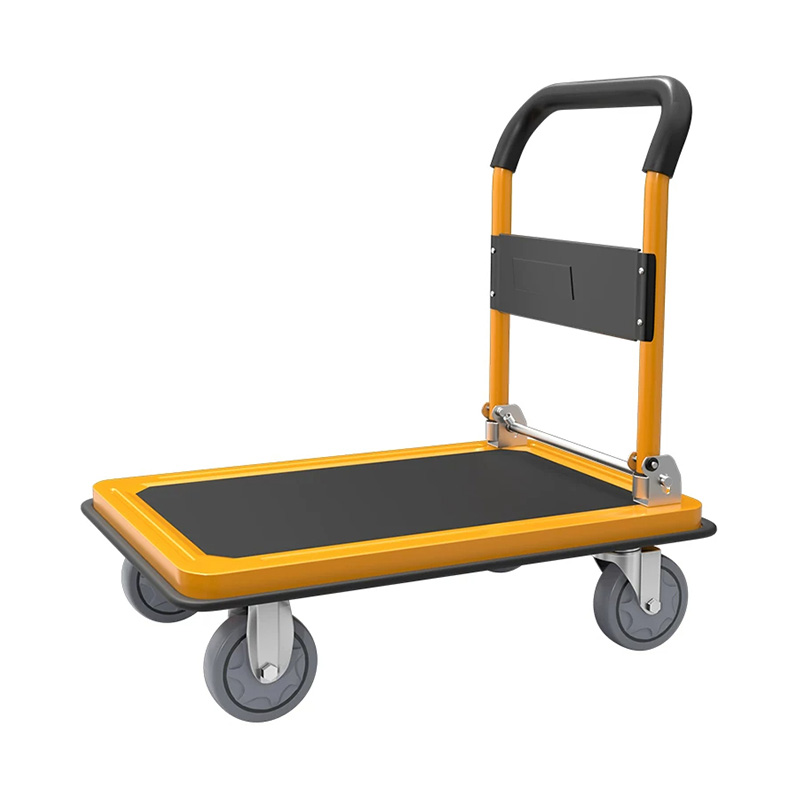 Foldable Heavy-Duty Platform Trolley with Load-Bearing BeamA reinforced flatbed alternative for repeated loading, with a load-bearing beam, foldable frame, 200–400 kg capacity, and multiple platform, wheel, and color options.View Product →
Hinges, Latches, and Conversion Feel
The conversion joint is the part most likely to annoy users and the part most likely to fail quietly. A latch should engage with a clear click, sit flush, and stay captured if the spring weakens. Exposed cotter pins are easy to lose; captive pins and tethered levers are better for route work. On a loaded test, shake the frame sideways and watch the hinge line. Any visible movement will grow with use.
Maintenance is straightforward: inspect the hinge for elongation, clean grit from the pivot, lubricate metal-to-metal contacts, and replace worn pins before they oval the holes. Operators should never force a bent frame back into alignment. A bent hinge changes the wheel contact and can make a flatbed pull to one side. A folding flatbed with silent casters can suit compact storage and light delivery work when the upright mode is not needed.
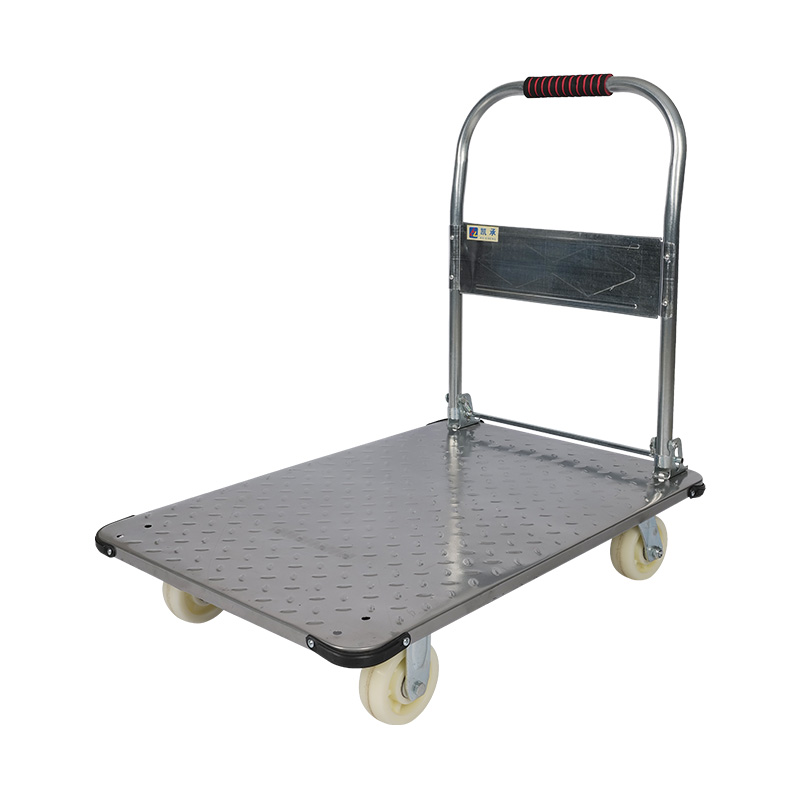 BT-Foldable Silent Flatbed for Compact StorageA foldable flatbed for compact storage and light delivery, available in two sizes with 150 kg or 300 kg load ratings and black or blue finishes.View Product →
Wheels, Casters, and Floor Conditions
Wheel choice matters more than most buyers expect. Large wheels roll over cracks and gravel; small casters steer well in aisles but catch on thresholds. Solid rubber tires resist punctures but transmit vibration. Pneumatic tires cushion rough ground but need pressure checks. Polyurethane and TPR treads are common for indoor floors because they roll quietly and resist marking, but they can flatten under long static loads.
Check wheel diameter, tread material, bearing type, and caster rating separately. A convertible dolly hand truck with four small casters may be rated for a high total load but still stumble on a half-inch lip. For outdoor use, look for wheels of at least 8 inches and a frame that does not place the caster forks outside the deck footprint. Brakes are useful on ramps and in loading bays, but they must be easy to reach with a loaded deck.
In tight aisles, a compact folding platform truck with casters can complement a larger convertible unit. It keeps the deck low and the turning circle small for stockroom work.
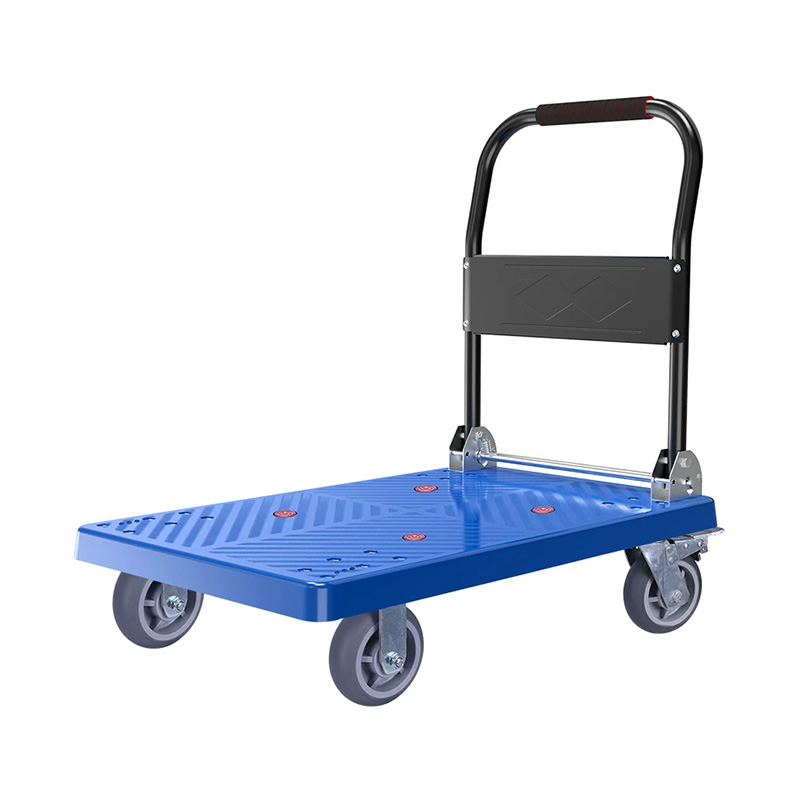 Compact Foldable Platform Trolley for Tight AislesA compact platform trolley with a low deck and small turning circle, available in multiple sizes and wheel options with 50–600 kg load ratings.View Product →
Match the Truck to the Route and Cargo
Delivery work involves mixed loads, frequent stops, and van floors. A convertible model saves space in the vehicle and handles both tall boxes and wide parcels. Retail restocking favors a flatbed with quiet casters and a low deck, because staff repeat the same short route many times per shift. Workshops need a stiff frame, protected wheels, and a deck that can take metal parts without denting. Event setup often demands one person to move cases, panels, and stands through service corridors and over cables.
Stairs are a separate question. A convertible dolly hand truck is not a stair climber, and using one on a full flight increases the risk of a load shift. If stairs are routine, specify a stair-climbing hand truck or a powered option. For mostly flat routes, a dolly versus hand truck decision guide can help separate the geometry of a two-wheel truck from a four-wheel platform before choosing a convertible compromise. Also confirm the folded footprint, the deployed length, and the height of the collapsed frame against the van or storage closet.
Procurement Checks Before Ordering
Buyers should compare a convertible dolly hand truck with a short, practical checklist rather than a single capacity figure. A supplier that manufactures metal handling equipment should be able to provide drawings, material specs, and wear-part numbers. The following points reduce the risk of a container arriving with trucks that suit the catalog but not the route.
- Confirm the rated load in both upright and flat positions, including the test standard.
- Ask for tube gauge, deck thickness, hinge pin diameter, and caster load rating.
- Request a loaded conversion test at 80 to 90 percent of the working load.
- Check finish quality at welds and pivot points, where coating can hide sharp edges.
- Set spare parts: wheels, brake casters, latch springs, and pins.
- Review packaging for export, including deck protection and container loading.
For a fleet order, request a sample unit and run it on the actual route for a week. Record where it catches, where the load shifts, and which parts loosen. That evidence is more useful than a catalog photo. A manufacturer with in-house metal fabrication and export packing experience can also adjust deck size, handle height, or caster configuration when volumes justify it.
A convertible dolly hand truck is a compromise by design, but a good one can replace two pieces of equipment in a van or stockroom. The priorities are a positive latch, a frame that stays stiff in both positions, wheels that match the floor, and a working load that leaves a safety margin. Price the spare parts at the same time as the truck, because the cheapest unit is rarely the cheapest to keep in service.
If you are specifying a batch for delivery, retail, or workshop use, send the load dimensions, floor conditions, and route details through the contact page so the frame and caster specification can be checked against the real job.


