

 English
 Español
When it comes to moving heavy loads in a warehouse, retail backroom, or delivery operation, two tools come up again and again: the hand truck and the dolly. They are often confused with each other — and sometimes even used interchangeably in conversation — but they are fundamentally different tools designed for different tasks. Understanding that difference is not just a matter of terminology; it directly affects workplace safety, operational efficiency, and the cost of your material handling investment. This guide covers what each tool is, how they differ structurally and functionally, and how to choose the right one for your operation. For a deeper technical breakdown, see our complete guide to hand trucks.
Content
What Is a Hand Truck?
A hand truck — also called a two-wheeler, sack truck, or utility dolly — is an L-shaped material handling tool built around three core components: a vertical metal frame with an upright handle at the top, two large rear wheels at the base, and a small horizontal toe plate (also called a nose plate) that slides beneath the load at ground level.
The operating principle is straightforward. The operator slides the toe plate under the item to be moved, then tilts the frame backward until the load rests against the vertical backplate and balances over the two wheels. This shifts the item's weight onto the axle, allowing a single person to transport loads that would otherwise require multiple workers or mechanical equipment. Most standard hand trucks support between 300 and 600 lbs, with heavy-duty steel models capable of handling up to 800 lbs or more.
Hand trucks are available in several configurations:
- Upright (utility) hand truck — The standard design for general-purpose use, ideal for boxes, appliances, and stacked goods.
- Appliance hand truck — Features reinforced frames, straps, and often stair-climbing wheels for moving refrigerators, washing machines, and heavy equipment.
- Convertible hand truck — Switches between two-wheel upright mode and four-wheel platform mode, offering the flexibility of both tools in one unit.
- Stair-climbing hand truck — Equipped with a tri-wheel or stair-glide mechanism to navigate steps safely.
The hand truck's primary advantage is its ability to slide beneath items without requiring any manual lifting to load. The operator positions the tool, tilts, and moves — reducing physical strain and lowering the risk of back injuries significantly.
What Is a Dolly?
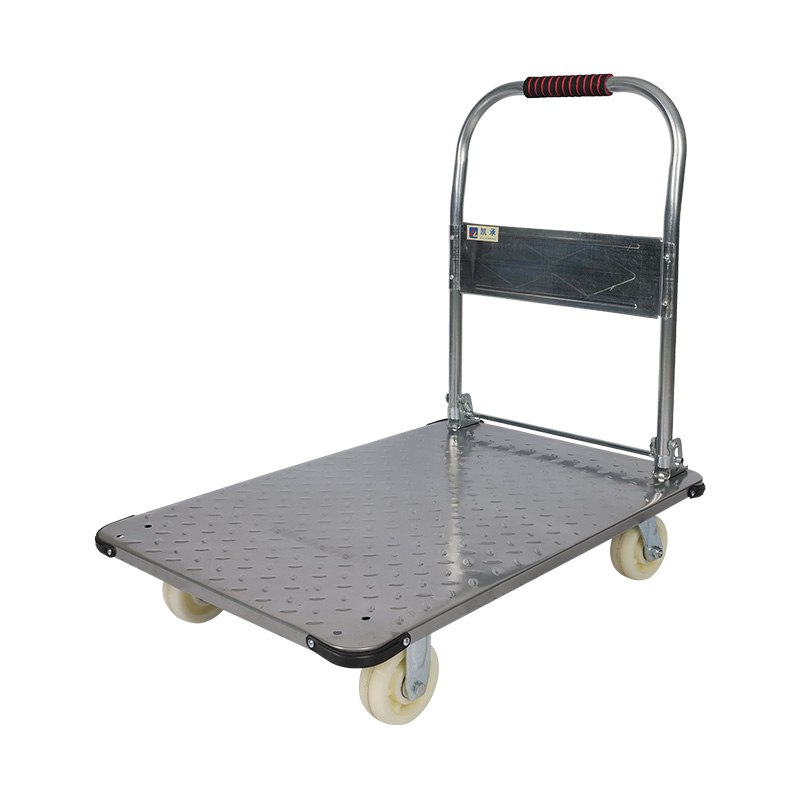
A dolly — also referred to as a platform dolly, moving dolly, or furniture dolly — is a flat, low-profile platform mounted on four wheels and two axles. Unlike a hand truck, a dolly does not tilt or stand upright on its own. It sits flat on the floor, and items must be lifted onto the platform before transport begins.
The four-wheel design gives the dolly a key advantage: omnidirectional mobility. Most dollies use swivel casters that allow the platform to be pushed, pulled, or rotated in any direction without repositioning the operator. This makes dollies particularly well-suited for navigating open warehouse floors, loading docks, and large retail spaces.
Common dolly types include:
- Furniture dolly — A flat wooden or metal platform with four corner casters, designed for sofas, dressers, and large appliances.
- Appliance dolly — A wider, reinforced platform with side rails for washing machines and commercial kitchen equipment.
- Platform (pallet) dolly — A heavy-duty flat platform for industrial use, capable of handling loads exceeding 1,500 lbs.
- Multi-layer folding cart dolly — Combines a flat platform with vertical shelving levels for transporting multiple smaller items simultaneously.
Because the dolly's platform is elevated slightly off the floor, loading requires either lifting or using a ramp — a consideration that matters in high-frequency operations where loading time adds up.
Hand Truck vs Dolly: Key Structural Differences
At a glance, both tools move heavy items from point A to point B. But their structural differences lead to very different performance characteristics depending on the task.
| Feature | Hand Truck | Dolly |
|---|---|---|
| Design | L-shaped, vertical frame | Flat horizontal platform |
| Wheels | 2 large fixed rear wheels | 4 swivel casters |
| Typical load capacity | 300–800 lbs | 500–1,500+ lbs |
| Loading method | Slide toe plate under item — no lifting needed | Lift item onto platform required |
| Directional movement | Forward/backward, tilted | Omnidirectional (push, pull, rotate) |
| Best surface | Smooth floors, ramps, stairs (with attachment) | Smooth, flat warehouse or retail floors |
| Space requirement | Narrow — works in tight aisles and doorways | Wider turning radius needed |
| Best for | Tall, heavy, stackable items | Wide, heavy, irregular or flat items |
One important distinction that catches many buyers off-guard: a hand truck tilts the load, which means tall items are transported at an angle. A dolly keeps the load perfectly level throughout transport — a critical requirement for fragile goods, liquid containers, or equipment with internal components sensitive to tipping.
When to Use a Hand Truck vs a Dolly
The right tool depends on the nature of the load, the operating environment, and how frequently the equipment will be used. Here are the most common scenarios and which tool fits best.
Use a hand truck when:
- You are moving boxes, cartons, or stacked goods through narrow aisles or doorways.
- The route includes stairs, ramps, or uneven surfaces — hand trucks with large pneumatic or stair-climbing wheels handle these far better than dolly casters.
- The items are tall but not excessively wide, such as appliances, file cabinets, or stacked inventory.
- You need to move items without additional lifting — sliding the toe plate under the load is faster and safer for frequent transport tasks.
- You are operating in a delivery or retail environment where maneuvering in tight spaces is common.
Use a dolly when:
- The load is wide, flat, or irregularly shaped — furniture, large equipment bases, or bulky machinery that cannot balance on a tilted two-wheel frame.
- The transport surface is a smooth, open warehouse floor where the dolly's swivel casters can move freely in any direction.
- The load must remain level throughout — glassware, electronics, sensitive equipment, or anything that must not tip.
- You are moving extremely heavy loads beyond 800 lbs — heavy-duty platform dollies are engineered for this weight class.
- Multiple workers need to control a single large load from different sides simultaneously.
In many warehouses and distribution centers, the most efficient approach is to maintain both. Hand trucks handle the daily picking and replenishment runs; platform dollies take on heavy machinery, bulk pallet loads, and oversized cargo.
Convertible and Foldable Options
For operations that encounter both vertical stacking tasks and flat platform tasks, convertible and foldable designs offer a practical middle ground.
A convertible hand truck switches between two-wheel upright mode and four-wheel platform mode by folding the frame flat. In upright mode it functions as a standard hand truck; folded flat it acts as a compact platform dolly. This flexibility is particularly valuable in warehouses and retail environments where both load types appear regularly, and where purchasing and storing two separate units is impractical.
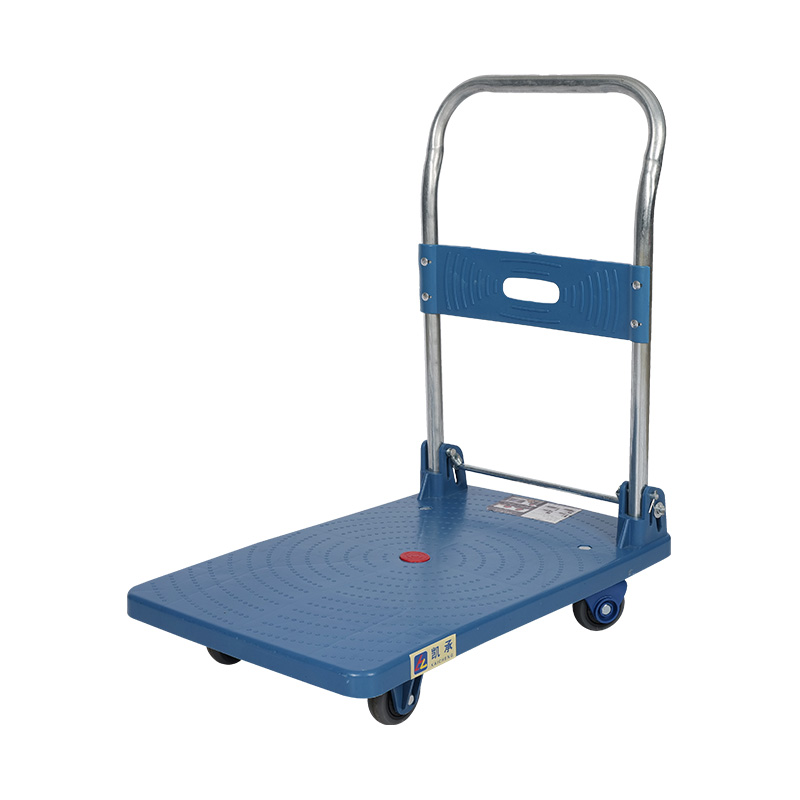
Foldable transport carts take a different approach: rather than switching between two modes, they collapse completely when not in use — reducing their footprint to a fraction of their operational size. This makes them an ideal fit for e-commerce logistics, home delivery fleets, and space-constrained retail backrooms. A well-engineered metal foldable trolley with a one-click folding mechanism can be deployed in seconds and stored flat in a van, storeroom, or apartment hallway without occupying significant space.
For businesses moving a high variety of goods — some tall and stackable, others wide and flat — a convertible or foldable unit can eliminate the need for two separate purchases while covering the majority of daily handling tasks.
Choosing the Right Tool for Your Operation
For buyers sourcing material handling equipment at scale — whether for a distribution center, a retail chain, or resale — the selection criteria go beyond basic function. Here is a practical framework for making the right call.
1. Define the load profile
What is the average weight of the loads you move? What are their dimensions and shape? Tall, stackable boxes favor hand trucks. Wide, flat, or extremely heavy loads favor dollies. Mixed load profiles favor convertibles.
2. Assess the operating environment
Smooth concrete or tile warehouse floors allow dolly casters to perform at their best. Ramps, rough surfaces, outdoor terrain, and stairwells favor hand trucks with large-diameter wheels. Environments with both conditions benefit from keeping both types available.
3. Consider frame material and finish
Steel frames offer the highest load capacity and durability for industrial use. Aluminum frames are significantly lighter — an important factor for hand trucks that workers carry and reposition frequently. Surface treatment (powder coating, galvanizing, chrome) affects corrosion resistance for outdoor or humid environments. As an OEM manufacturer, Bintai Machinery produces both steel and aluminum hand trucks and platform dollies to custom specifications, including adjustments to frame gauge, toe plate dimensions, wheel type, and surface finish.
4. Factor in storage and transport of the equipment itself
If floor space is at a premium or equipment needs to travel with a delivery vehicle, foldable designs significantly reduce the footprint. Non-folding hand trucks and large platform dollies require dedicated storage space — a real cost in high-density facilities.
5. Calculate total cost of ownership, not just unit price
A lower-priced hand truck with inferior wheel bearings or a weak frame weld will require replacement far sooner than a properly engineered unit. For high-frequency operations, the cost difference between a basic and a durable unit is recovered quickly through reduced downtime and replacement costs. For a full breakdown of types and specifications to consider before purchasing, refer to our hand dolly selection guide.


